





Every Child Deserves Safety—No Matter Where They Go to School
By Claudia T. Nachtigal, MATS, Head of School, The Highlands School
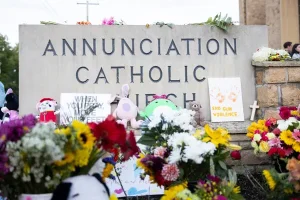
On August 27, 2025, the unthinkable happened at Annunciation Catholic School in Minneapolis. During a morning Mass, a gunman opened fire through the stained-glass windows, killing two children—eight-year-old Fletcher Merkel and ten-year-old Harper Moyski—and injuring 17 others, including parishioners who had gathered to pray.
The next morning, flags across the nation flew at half-staff. It was a solemn and moving tribute, a recognition from our federal government that these children mattered—that their lives were worthy of national mourning. And yet, here lies the contradiction: if our leaders can honor these children in death, why can’t they protect them in life? If we as a nation believe they were worthy of remembrance, then surely they, and every child, are also worthy of security.
This tragedy exposes a gap in how we think about safety. Public schools rightly receive government support for security measures. Independent schools, however, are often left to fend for themselves—relying on tuition and fundraising to pay for protections like secure entry systems, trained personnel, and mental health support. That divide is indefensible. Violence does not pause at the doors of independent schools. It does not ask to see a tax filing before pulling a trigger.
In Maryland, for example, independent schools like mine can apply for state security grants. But why should a child’s safety depend on winning a grant competition? Why should protection hinge on applications, renewals, and red tape? And even when awarded, the funding is limited—covering cameras or locks, but not the ongoing presence of resource officers or counselors who can prevent and de-escalate crises. Meanwhile, I can’t even get a school speed limit sign in front of our building. If we can’t guarantee the basics, how can we claim to be serious about safety?
Safety is not a luxury; it is a public good. It is the most basic responsibility of the government to protect its citizens, especially its children. To say that independent schools must shoulder safety costs alone is to suggest that the children inside them are somehow less valuable, less deserving of protection. That is both inequitable and dangerous.
Critics may argue that families who choose independent schools accept the responsibility of covering costs. But these families are taxpayers too. They contribute to the same public funds as everyone else, yet their children are excluded from protections those resources could provide. It is not a matter of subsidizing private education; it is a matter of guaranteeing a baseline of security for all children.
In truth, the lines are not as rigid as some make them out to be. Many states already extend certain public resources to independent schools: transportation funding and public health services. Why? Because policymakers understand that protecting children benefits the entire community. When a crisis occurs at any school, the impact ripples outward—to first responders, to neighborhoods, to cities. Ensuring safety everywhere is not just compassionate; it is pragmatic.
The Annunciation tragedy is a case in point. Minneapolis is grieving not because the victims attended an independent school, but because they were children. They were sons and daughters, classmates and teammates. Their absence leaves holes in families, schools, and neighborhoods alike. To divide our response along institutional lines is to miss the heart of the matter: all children belong to all of us.
The image of flags at half-staff should stay with us, but not as the end of the story. Symbols without action become hollow. If the federal government, and the state of Maryland, can lower flags in memory of two children from an independent school, then it must also be willing to raise its commitment to protecting others like them. Anything less is a contradiction we cannot afford.
Every year, after each tragedy, we hear the same refrains: thoughts and prayers, calls for unity, vows that the victims will not be forgotten. And then, too often, nothing changes. This time, let us honor Fletcher and Harper with more than lowered flags. Let us honor them by ensuring that every child, in every school, walks into a classroom that is as safe as we can possibly make it.
The question is not whether government can fund safety in independent schools. It is whether we have the will to affirm that every child—public, private, or parochial—is equally worthy of protection. Because until we treat safety as a shared responsibility, we will continue to leave children exposed and ideals unfulfilled.
Every child deserves to learn, grow, and dream in safety. And every child deserves a government willing to make that promise real.
Claudia Nachtigal is the Head of School at The Highlands School, a K-8 institution for students with learning differences and achievement gaps located in Bel Air, Maryland. She is dedicated to helping students overcome challenges to achieve success in a nurturing environment that emphasizes the importance of direct social interactions, empathy, and confidence.